
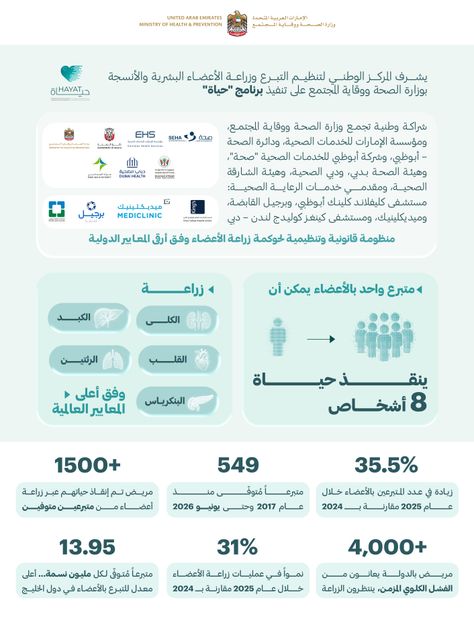
The United Arab Emirates (UAE) is making significant strides in organ donation and transplantation, as highlighted by the recent achievements of the National Organ Donation and Transplantation Programme, “Hayat“. Established by the Ministry of Health and Prevention, this initiative has restored hope to over 1,500 patients since its launch in 2017, leveraging the generosity of deceased donors to facilitate life-saving surgeries across the country.
Impressive Statistics and Achievements
As of June 2026, the programme has successfully facilitated the transplantation of 1,780 organs, consisting of 924 kidneys, 502 livers, 181 lungs, 151 hearts, and 22 pancreases. The rapid growth in organ donation is evident, with 549 deceased donors contributing to the cause and a remarkable 35.5% increase in donations within a single year. Notably, more than 550 organs have been exchanged between the UAE, Saudi Arabia, and Kuwait, showcasing the region’s commitment to collaborative health initiatives.
Healthcare Quality and Legislative Framework
The achievements of the “Hayat” Programme reflect the UAE’s vision for healthcare, underscoring the priority of human health and quality of life. This advanced healthcare model integrates humanitarian values, effective legislation, and exceptional medical practices, positioning the UAE as a regional and global leader in organ donation and transplantation. The clinical outcomes rival those of the world’s best centres, credited to a comprehensive system that adheres to the highest standards of quality and safety.
Comprehensive Approach and Specialised Centres
Transplantation services are provided through nine accredited centres across the UAE, each offering a variety of specialised treatments. In Abu Dhabi, the Cleveland Clinic Abu Dhabi performs heart and lung transplants, along with liver, kidney, and pancreas transplants. Meanwhile, Sheikh Khalifa Medical City caters to both adults and children needing liver and kidney transplants, while Burjeel Medical City provides similar services. In Dubai, hospitals cater specifically to adult and paediatric patients, ensuring a wide array of available care.
Innovation and Technological Advancements
The “Hayat” Programme champions a global health system that emphasises efficiency and sustainability while harnessing advanced medical technologies to improve transplant outcomes. This approach aligns with the UAE’s commitment to enhancing preventive healthcare, promoting innovation, and focusing on quality of life. As a result, many patients can return to their communities and lead full lives, thus contributing to the objectives of the “We Are the UAE 2031” vision.
Addressing Urgent Healthcare Needs
Approximately 4,000 patients in the UAE await kidney transplants, illustrating the urgent need for increased organ availability. The programme is committed to expanding the available organs while minimising wait times by raising awareness about donation, expediting evaluation and matching processes, and bolstering living donor and paired donation initiatives.
Regulatory and Support Framework
The National Centre for Organ Donation and Transplantation manages all related activities, from procedures to the development of policies ensuring quality and safety. Since inception, the programme has trained over 10,000 healthcare professionals in organ donation, establishing a national network of over 150 health staff that supports various stages of donation and transplantation.
Recognition and Support for Donors
The programme also provides numerous benefits and recognitions for donors and their families, acknowledging their invaluable contributions to society. This includes priority access to organ transplants and various support services, which aim to ease the recovery process and bolster the sense of community around organ donation.
Future Directions and Community Engagement
Looking ahead, the UAE aims to enhance efforts in promoting organ donation, expanding recovery units within hospitals staffed by trained professionals, and integrating newer procedures that account for cardiac death donations. Educational campaigns will also continue to foster a culture of organ donation within society, spotlighting the importance and impact of such altruistic actions.
Dr. Amin Al Amiri, Assistant Undersecretary for Health Regulation at the Ministry, affirmed that the achievements of the “Hayat” Programme exemplify the leadership’s vision for a robust health system prioritising human well-being. He emphasised the ongoing commitment to expand the programme, utilise cutting-edge technologies, and foster fruitful regional and international collaborations while promoting the life-affirming message of organ donation.