
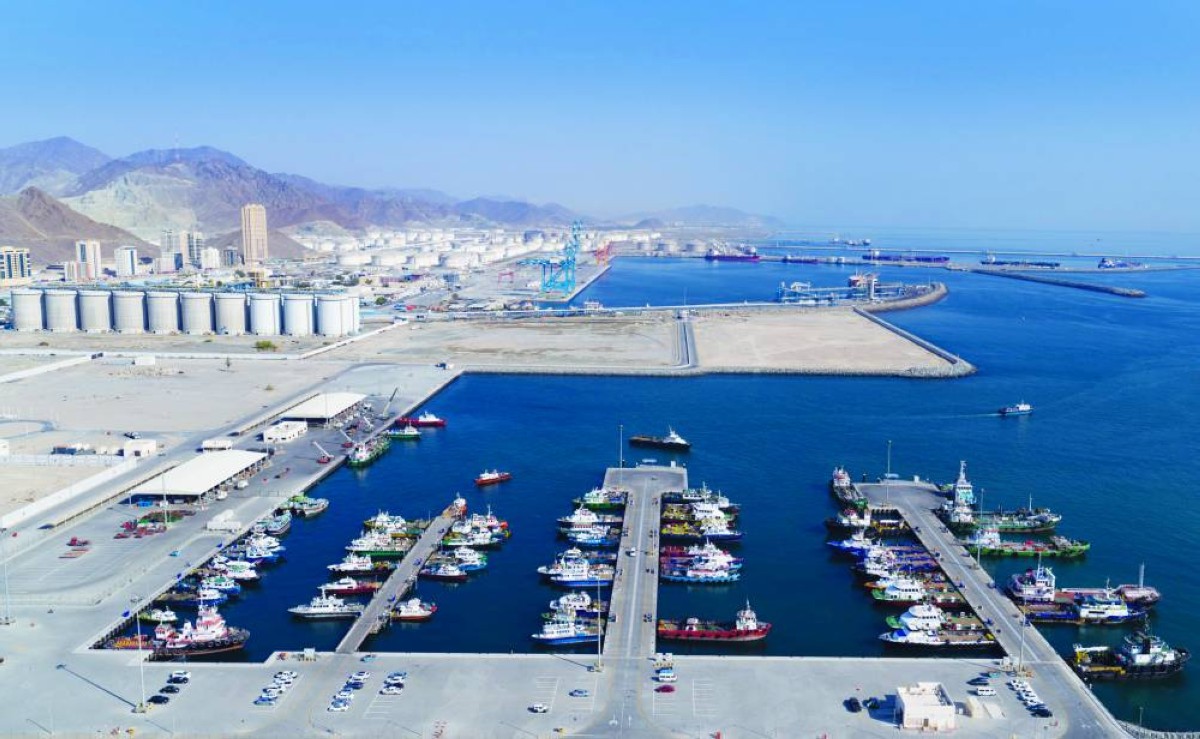
Fujairah Port stands out as one of the United Arab Emirates’ most important strategic maritime assets, benefiting from its unique location on the country’s eastern coast overlooking the Arabian Sea and the Gulf of Oman. That position has given it a growing role in supporting international trade and strengthening the resilience of national supply chains.
With the announcement of the development of Al Rugailat and Dibba Fujairah ports, in partnership with DP World, the UAE’s ports ecosystem is entering a new phase of expansion aimed at increasing capacity, diversifying trade corridors, and connecting local production and consumption centres with global markets.
The project is not merely an addition to container and cargo handling capabilities. It forms part of a broader strategy to turn the UAE into an integrated global hub for trade and logistics, built on an interconnected network of ports, free zones and industrial centres.
Ports are no longer limited to receiving ships and loading or unloading cargo; they have become integrated economic centres that help determine a country’s competitiveness in the global economy. In this context, Fujairah Port is one of the key pillars of the UAE’s logistics strength, drawing on its strategic location and the national network of interconnected ports to add further resilience to a trade system that can adapt to global shifts.
A vital link
Fujairah Port’s importance lies in its position on one of the world’s most important maritime routes. It provides direct access to the Gulf of Oman, the Arabian Sea and the Indian Ocean, making it an important transit point for trade flows between Asia, the Middle East, Africa and Europe.
This location gives the UAE greater ability to manage goods flows and reduce the risks associated with reliance on specific sea routes, particularly amid the challenges global trade has faced in recent years, from supply chain disruptions to rising transport and shipping costs.
Its location on the eastern coast also strengthens the country’s ability to offer companies alternative and flexible options for import, export and re-export operations.
A central role
The UAE’s ports are among the main engines of growth in foreign trade, providing the infrastructure that connects local businesses with global markets.
Fujairah Port’s role extends far beyond receiving vessels. It covers a wide range of maritime and logistics services, from cargo storage and container management to ship services, bunkering and maintenance.
Fujairah is home to one of the world’s largest marine fuel supply hubs, reinforcing its status as an integrated maritime centre and attracting global companies operating in shipping, energy and marine services.
The UAE’s maritime strategy is based on integration between its ports. Jebel Ali Port in Dubai serves as a major hub for global trade and re-export, while Fujairah Port provides a strategic outlet on the Arabian Sea.
Linking Fujairah Port with DP World’s logistics network, Jebel Ali Port and Jebel Ali Free Zone (Jafza) would create an integrated supply chain, enabling companies to move goods efficiently between ports, industrial zones and end markets. That means greater capacity to manage trade flows, reduce cargo transit times and improve logistics efficiency — all factors that have become essential to the competitiveness of modern economies.
The development of Al Rugailat and Dibba Fujairah ports is an extension of the UAE’s plans to expand its maritime capabilities. Al Rugailat Port will add capacity of 2.5 million twenty-foot equivalent units a year, as well as 1.7 million tonnes of general cargo and 190,000 car equivalent units, while Dibba Port will add around 3.6 million tonnes of general cargo annually.
With these new operating capacities, DP World’s container-handling capacity in the UAE rises to around 22 million twenty-foot equivalent units a year, reflecting the continued expansion of the country’s maritime infrastructure.
The strength of the UAE’s logistics sector rests on a set of interconnected factors, including geography, advanced infrastructure, free zones, digital systems and ease of doing business.
Developing Fujairah Port also fits within a wider effort to strengthen the UAE’s position as a key hub for global trade, particularly as e-commerce grows, demand increases for regional distribution centres and the importance of flexible supply chains rises.
Port expansion also helps attract new industrial and commercial investment, create jobs and support transport, warehousing and trade-related services.