
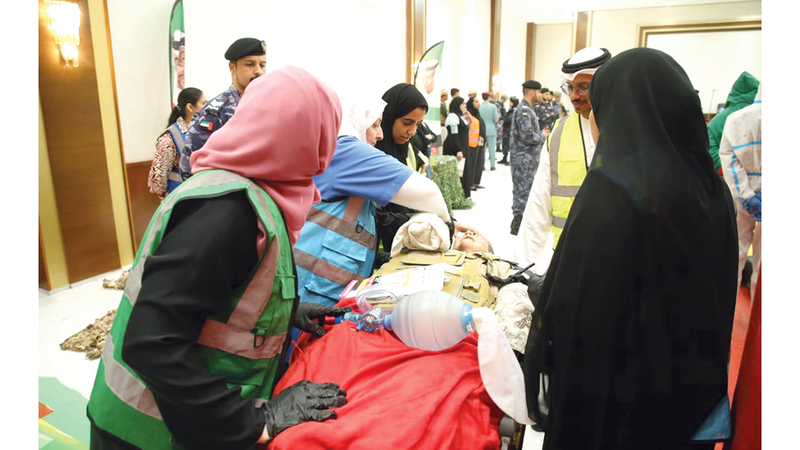
The UAE National Medical Readiness and Response Programme, “Jahiziah”, has launched a specialised national initiative to develop the skills of Emirati paramedics and first responders across the civilian and military sectors through a unified, internationally accredited training framework. The programme is the first of its kind nationally and aims to strengthen the capabilities of front-line personnel and improve their readiness to deal with a wide range of incidents, emergencies, crises and disasters.
The programme was developed and approved in collaboration with Al Wataniya Training, Jahiziah Academy, the European Centre for Disaster Medicine, the British Association for Immediate Care, the American Academy of Emergency Services, and the American College of Surgeons. It is built on a scientific and practical framework based on the best international standards and practices in emergency medicine, disaster medicine, medical response and ambulance services.
Unified training for civilian and military responders
The initiative seeks to standardise specialised training for Emirati paramedics and first responders, embed unified concepts and procedures for field operations, and improve leadership, coordination and communication mechanisms between civilian and military institutions. The aim is to reinforce the integration of roles and raise the efficiency of joint response across a variety of emergency conditions and scenarios.
The programme uses a comprehensive training model that combines theoretical lectures, practical training, advanced simulation exercises and joint field scenarios involving multiple entities. This approach is designed to prepare national cadres to operate efficiently and professionally within a unified national system for readiness and response.
Building skills for major incidents and complex threats
Dr Adel Al Shamri Al Ajmi, Chief Executive of Zayed Giving Initiative and Chief Executive of the UAE National Programme “Jahiziah”, said the programme focuses on developing the specialist and practical skills of Emirati paramedics and preparing them to respond to major incidents, mass casualty injuries and health, chemical, biological, radiological and nuclear hazards. He added that it also aims to enhance their capabilities in leadership, coordination, communication and decision-making during crises.
International support and the role of simulation
Professor Roberto Maggiore, President of the European Centre for Disaster Medicine, said that unifying training across civilian and military institutions strengthens coordination and integration between teams during major incidents, and improves leadership, communication, task allocation and decision-making under pressure. He noted that the success of the pilot phase, which trained and qualified thousands of paramedics and first responders, provides a strong base for expanding the programme nationally, alongside the importance of preparing accredited Emirati trainers and continuously updating the curricula.
He added that training based on simulation and multi-agency joint scenarios is among the most important modern tools for measuring readiness, identifying areas for improvement, and increasing the efficiency of individuals and institutions in responding to emergencies, crises and disasters.