
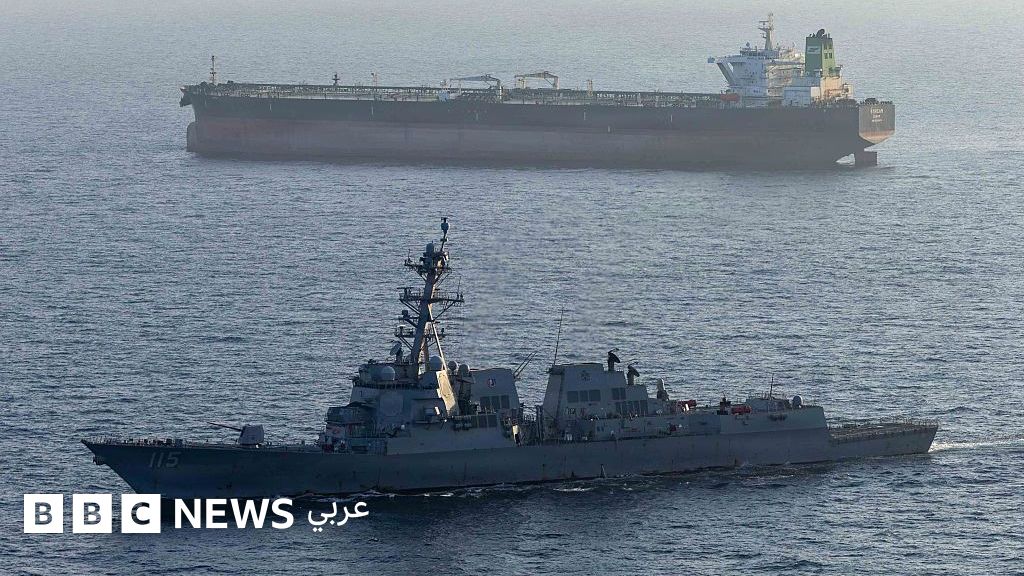
US strikes on Iran continued for a seventh straight night on Friday, as tensions widened across the region and Tehran accused Washington of targeting infrastructure in the Gulf. Iranian state media also reported fresh attacks and casualties inside Iran, while maritime security remained under intense pressure around the Strait of Hormuz and beyond.
Iran says tankers hit by sea mines near Hormuz
On Saturday, Iran’s Islamic Revolutionary Guard Corps said two oil tankers had exploded and caught fire after striking naval mines while passing through the Strait of Hormuz.
Iran’s official IRNA news agency quoted a Guard statement saying: “About an hour ago, two oil tankers were blown up and set on fire as they attempted to pass through a minefield south of the Strait of Hormuz”.
The Guard also accused US intelligence agencies of “misinformation”, saying they had directed the tankers to travel through the area. US Central Command, or Centcom, rejected that account and dismissed it as untrue, without providing further detail.
Tehran announces strikes across the region
In the same statement, the Revolutionary Guard said it had destroyed the “main artificial intelligence intelligence centre in Bahrain” using ballistic missiles and drones.
Iranian state television also reported the military as saying it had targeted US camps and bases in Kuwait and Jordan. The Guard further said four so-called “violating” oil tankers had been stopped in the Strait of Hormuz during an operation carried out with missiles and drones, though that claim could not be independently verified.
IRNA reported on Saturday that US attacks had killed three people and wounded eight others in Hormozgan province in southern Iran.
In a Telegram post, the agency said: “The deputy governor of Hormozgan for political, security and social affairs announced the martyrdom of three people and the injury of eight others as a result of hostile attacks targeting areas in Hormozgan province this morning”.
That followed reports from state television of three explosions heard in the southern city of Sirik. The Mehr news agency said areas in the south-western city of Ahvaz had also been hit by US missiles.
Mehr added, citing a local official, that projectiles launched by “the enemy” landed outside the central city of Yazd, with no reports of injuries.
US campaign enters another night
US forces continued military strikes on Iran for a seventh consecutive night, alongside a tightening maritime blockade. Centcom said it had carried out another round of strikes against Iranian targets on Friday night.
The ongoing operations are intended “to weaken Iran’s military capabilities”, according to the US military.
Regional spillover grows
Amid the widening unrest, a security source told the BBC on Friday night that a drone had struck an arms and ammunition store locally known as the “baruthkhana”, behind the Tasaluja area near 100-metre Street in the Iraqi city of Sulaymaniyah.
The source said the attack caused a large fire at the site, followed by successive explosions as stored ammunition ignited.
Early on Saturday, Saudi Arabia‘s General Directorate of Civil Defence issued two early warnings to residents in the cities of Al Kharj and Yanbu, urging caution over a “potential danger”. It later said the danger had ended in both cities, without specifying what had prompted the alerts.
Escalation at sea and on land
Tehran said on Friday that Washington had struck at least five bridges inside Iranian territory, suggesting a shift in the target set to include infrastructure.
In response, Iran broadened its own target list and struck a power generation and water desalination station in Kuwait, marking a new escalation centred on regional infrastructure.
At sea, US forces remained on high alert to enforce “strict compliance with the blockade on Iranian ports”. During the first three days after the blockade resumed, US forces intercepted shipping movements to ensure compliance, diverting four commercial vessels, disabling one ship and subjecting another to a detailed inspection.
The developments have again disrupted global energy supplies moving through the Gulf. Near the Strait of Hormuz, US Marines boarded one oil tanker.
At the same time, armed men seized another vessel off the coast of Yemen, raising serious security concerns over navigation in the Bab al-Mandab, a second strategic artery for regional oil shipments.