
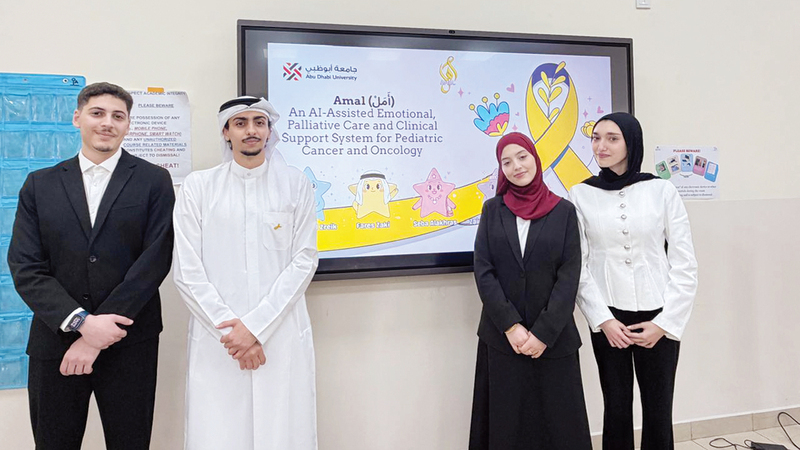
Four software engineering students at the College of Engineering at Abu Dhabi University have developed an integrated digital system called “Amal” to support children with cancer throughout their treatment journey, bringing together a child and parent app, a smart doctor dashboard and a single environment that combines psychological support, medical follow-up and continuous communication.
The platform, created by students Abdulwahed Zraig, Fares Zaki, Saba Al Akras and Zina Al Dardasawi under the supervision of the university’s Associate Professor of Computer Science and Information Technology, Dr Murad Al Rajab, is available in both Arabic and English so that children and families inside and outside the UAE can use it without language becoming a barrier.
Built on artificial intelligence, sentiment analysis, machine learning and virtual reality, the system offers an interactive experience designed to feel close to a child’s world and far removed from the complexity that characterises many medical applications.
The innovation won first place in the Innovation Competition and the Ras Al Khaimah Award for Excellence, as well as several other honours, including the Highly Commended Research Paper Award at Middlesex University.
A digital companion for the child
Fares Zaki said “Amal” acts as a digital companion that helps the child feel they are not alone, gives the family greater understanding and reassurance, and helps the doctor see the full picture of the patient’s condition.
The system includes a smart 3D companion that speaks to the child in simple, warm language, tells stories, shares games and interactive activities, and encourages the child to express feelings naturally. But the real innovation is not only on the screen; it lies in the details the user does not see. The free drawing space inside the app is not just a recreational activity, but a smart window that analyses emotional indicators indirectly, giving doctors and the child’s family a deeper understanding of the child’s psychological state without the child feeling monitored. “The team did not design a system that monitors the child, but a digital environment in which the child feels safe and confident.”
Support for families and doctors
Zaki said the project also addresses the most exhausting part of the treatment journey: the family’s daily anxiety and endless questions. For that reason, it provides tools for logging symptoms and tracking medication, alongside an AI Doctor Agent, a smart medical assistant that relies on trusted scientific sources to answer parents’ questions in simple language. It is not a substitute for the doctor, but a knowledge bridge that helps families understand the treatment journey when direct communication with the medical team is not available.
Abdulwahed Zraig said the smart dashboard enables medical staff to monitor symptoms, analyse emotional trends and track adherence to the treatment plan, helping them intervene early and giving the doctor a broader view of the patient’s progress rather than relying solely on test results.
He noted that the project gained this clinical depth through close collaboration between the university and the health sector, working with paediatric haematology and oncology specialist Dr Haitham Al Jaboori at Sheikh Khalifa Medical City, whose medical expertise helped align the technical solutions with the real needs of children with cancer and their families, as well as paediatric haematology and oncology specialist Dr Zain Al Abedin at Burjeel Hospital.
Keeping the human touch in digital care
Saba Al Akras and Zina Al Dardasawi said the greatest challenge was “providing technical support that does not lose its human side”, and that every detail in the platform was designed to be simple, safe and familiar to children, so that it offers comfort rather than adding a new burden to their fears.
Dr Murad Al Rajab described the project as a model that embodies the humanity of artificial intelligence, stressing that the true value of innovation is not measured by the number of algorithms used, but by its ability to improve human life and turn technology into a means of supporting the child, helping the family and assisting the doctor.
The team hopes to expand the use of “Amal” to hospitals and specialist medical centres across the UAE and the region, so that it becomes a lasting partner for children with cancer and their families throughout treatment.