
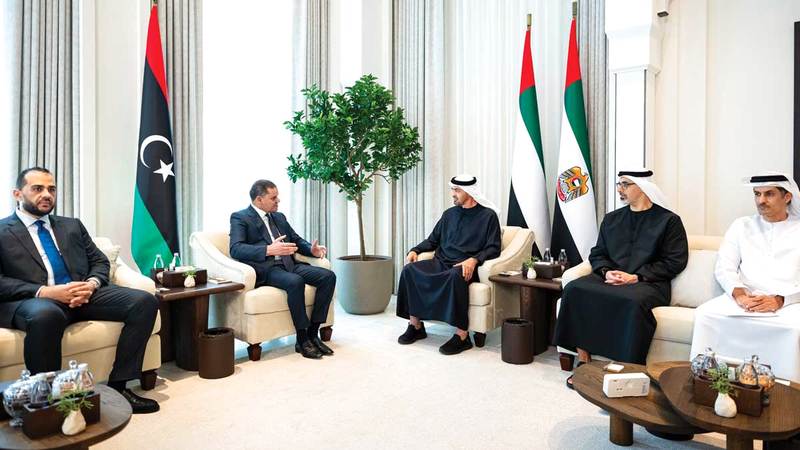
In a significant diplomatic engagement, the President of the United Arab Emirates and Abdulhamid Dbeibeh discussed regional issues and developments in the area. This meeting marks a key opportunity to explore the strengthening of bilateral relations between the United Arab Emirates and Libya, as both nations seek to address a range of regional challenges and pursue lasting stability in the Middle East.
His Highness Sheikh Mohamed bin Zayed Al Nahyan, President of the United Arab Emirates, received the Prime Minister of the Libyan Government of National Unity, Abdulhamid Dbeibeh, who is on a working visit to the UAE. During this productive meeting, the leaders focused on enhancing their bilateral relations to serve the mutual interests of both countries and their peoples.
The President and the Prime Minister exchanged views on several regional issues. The discussions also encompassed the evolving situations impacting the Middle East. Both leaders emphasized the importance of collaborative efforts aimed at fostering stability and sustainable peace in the region, reinforcing their commitment to improving the welfare of all its inhabitants.
Attending the meeting were His Highness Sheikh Khalid bin Mohamed bin Zayed Al Nahyan, Crown Prince of Abu Dhabi; His Highness Sheikh Hamdan bin Mohamed bin Zayed Al Nahyan, Deputy Head of the Presidency Office for Special Affairs; Sheikh Mohamed bin Hamad bin Tahnoun Al Nahyan, Advisor to the President; Sheikh Shakhbout bin Nahyan Al Nahyan, Minister of State; Secretary-General of the Supreme National Security Council, Ali bin Hamad Al Shamsi; and Dr. Ahmed Mubarak Al Mazrouei, Head of the President’s Office for Strategic Affairs and Head of the Abu Dhabi Executive Office, along with several officials.
The strategic discussions during this meeting highlighted the shared vision of both leaders for a peaceful and prosperous future in the region. With political developments continuously evolving, the discussions on regional issues and developments are crucial for aligning efforts toward common goals.