
In an ambitious initiative set to reshape the textile industry, “نسيج” aims to recycle over 220,000 tons of textiles annually, significantly contributing to the circular economy in the United Arab Emirates. This initiative reflects the country’s commitment to sustainability and innovation in the textile sector, aligning with global best practices.
Abdullah bin Touq Al Marri, the Minister of Economy and Tourism, confirmed that the national initiative “نسيج,” launched under the guidance of the wise leadership, contributes to recycling more than 220,000 tons of discarded textiles annually in the UAE, enhancing the country’s efforts towards a circular industrial transformation, particularly in the textile sector.
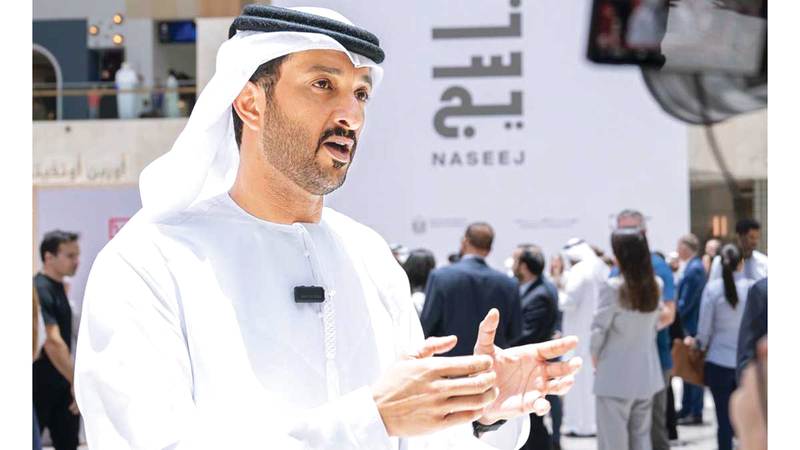
In statements to the Emirates News Agency (WAM) during the first community event of the “نسيج” initiative titled “نسيج الفرص,” held at Yas Mall in Abu Dhabi, he stated, “This volume of textiles represents an important economic resource that can be utilized through remanufacturing and recycling, supporting sustainability and enhancing resource efficiency.”
He emphasized that the national initiative “نسيج” opens new horizons for investors and entrepreneurs by presenting innovative ideas and projects that contribute to transforming the textile sector into a comprehensive circular economic system, with outputs that can benefit various sectors, including furniture and construction materials, among others.
Circular Economy Principles
He explained that the circular economy is based on the principles of reuse, recycling, and optimal resource utilization, through an integrated system that starts from the initial production stages to industrial waste that can be employed as inputs in other factories and sectors.
He pointed out that the UAE places significant emphasis on developing an advanced and integrated circular economy system, in line with global best practices. He noted that the Ministry of Economy and Tourism is working to connect different stages of production in the industrial sector through policies that support the establishment of geographically proximate factories, serving the circular economy system within a comprehensive industrial environment.
Enhancing Sustainability
Bin Touq affirmed that this direction contributes to enhancing the sustainability of the national economy while achieving environmental gains by reducing carbon dioxide emissions and decreasing reliance on imported products.
He explained that the circular economy represents one of the economies of the future in the UAE, and efforts are ongoing to develop supportive policies and strategies for this direction, alongside promoting community awareness related to the circular economy, thus solidifying the country’s position as a leading global hub in this field.
The Future of the “نسيج” Initiative
The “نسيج” initiative aims to enhance the UAE’s status as a global reference in the circular economy of textiles by aligning policies, industrial work, and community participation through a pioneering model that balances economic growth with environmental sustainability. The initiative also seeks to expand community events to include other regions of the country in the next phase, aiming to provide interactive experiences that encourage community members to understand the impact of textile waste, explore sustainable solutions, and participate in shaping a more sustainable future.
The upcoming phase is set to witness the implementation of a series of programs and initiatives supporting sustainable production, enhancing infrastructure for the collection, sorting, and recycling of textiles, along with developing research and pilot projects that enable the application of scalable circular solutions.