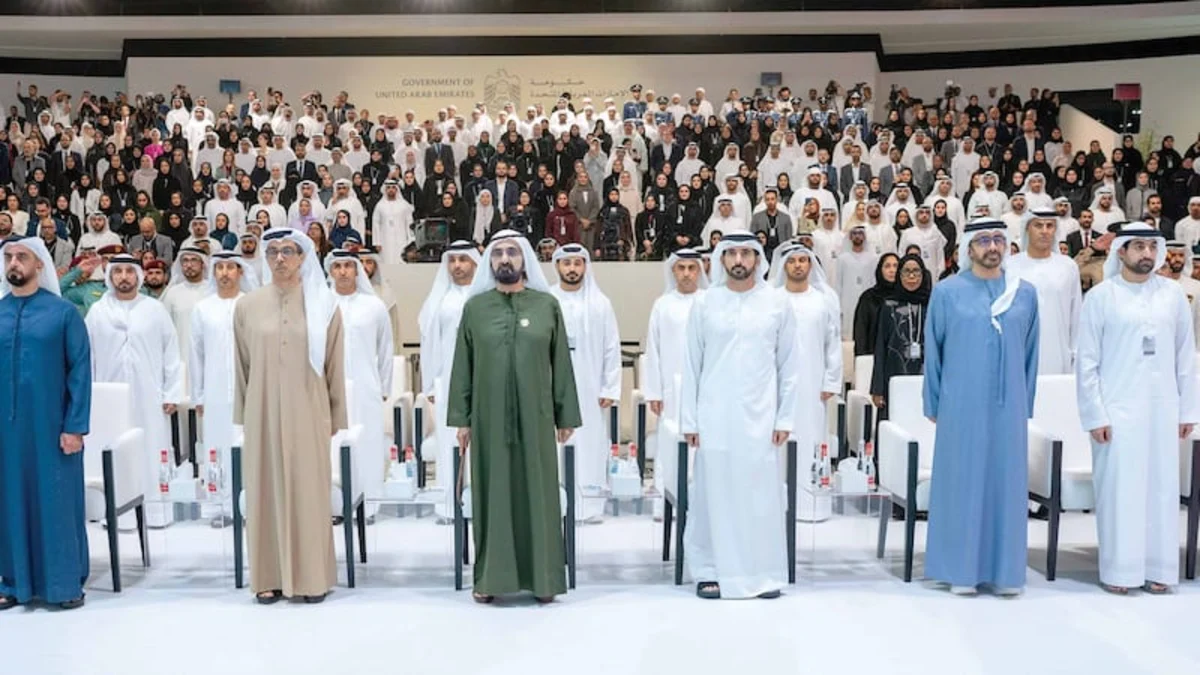
UAE Vice-President, Prime Minister and Ruler of Dubai Sheikh Mohammed bin Rashid Al Maktoum has unveiled a new model for government services, alongside Mira, a personal government assistant designed to help people complete transactions through a conversation. The initiative aims to replace the need to search across services and procedures with a more integrated, proactive experience powered by artificial intelligence.
The launch was attended by Vice-President, Deputy Prime Minister and Chairman of the Presidential Court Sheikh Mansour bin Zayed Al Nahyan, and Dubai Crown Prince, Deputy Prime Minister, Minister of Defence and Chairman of Dubai’s Executive Council Sheikh Hamdan bin Mohammed bin Rashid Al Maktoum. It took place at an event in Expo City Dubai, attended by ministers and government and media leaders, where officials demonstrated services planned for the first phase, due to be ready in March 2027. Further service packages will be introduced gradually.
Also in attendance were Deputy Prime Minister and Minister of the Interior Lt Gen Sheikh Saif bin Zayed Al Nahyan, Deputy Prime Minister and Minister of Foreign Affairs Sheikh Abdullah bin Zayed Al Nahyan, and Minister of Tolerance and Coexistence Sheikh Nahyan bin Mubarak Al Nahyan.
A new way to access government services
Mira is intended to let people describe what they need in everyday language, then help identify the right service and complete the required steps. Depending on the service, this can include checking information, confirming an application and carrying out the transaction. The assistant is designed not only to answer questions, but also to coordinate with relevant government entities and help complete services.
Speaking on X, Sheikh Mohammed said: “Today, by God’s grace, and in the presence of the 1,000 most senior officials in the federal government, we approved the new form of UAE government services: one interface for all government services, in the form of a personal assistant powered by artificial intelligence on the phone of every citizen, resident and visitor. People will be able to speak to it in their own simple language and request a government service, and the assistant will carry it out for them.”
He added: “The personal assistant Mira will not only answer all enquiries about government transactions; it will carry them out and coordinate with all the relevant entities. It will recognise the customer and provide their government documents, and offer its services 24 hours a day, from anywhere. This could be a parent of a pupil at a government school asking about their child’s academic performance, a patient following up on appointments and speaking to their doctor by phone, an investor renewing contracts, a retiree asking about pension information, or a citizen renewing a passport or identity card. This qualitative shift will be launched from March 2027, God willing.”
“Our goal is to make people’s lives easier and save them time. Our goal is a government that provides the best services in the world. What is coming is even better, God willing,” Sheikh Mohammed said.
He also said the UAE, under the leadership of President Sheikh Mohamed bin Zayed Al Nahyan, was continuing to develop government work and use the latest technologies to serve people, improve quality of life and strengthen the country’s position as a global model for efficient, proactive government services.
Services designed around people’s needs
Minister of Cabinet Affairs and Chairman of the National Committee for Artificial Intelligence, Mohammad Abdullah Al Gergawi, said the new model marked a major step in government development and reflected Sheikh Mohammed’s direction to redesign government work using AI.
“The launch of the new form of government services embodies Sheikh Mohammed bin Rashid Al Maktoum’s vision of moving from a government that provides services to one that understands people’s needs, anticipates them and fulfils them using artificial intelligence,” he said.
“The personal government assistant Mira represents a new model for interaction between people and government. Customers no longer need to search for a service or know its procedures; they simply explain what they need and the process of completing their transaction begins.”
Al Gergawi said the change went beyond digitising services and procedures to redesigning the government experience. The aim, he said, was to use AI to provide more connected and faster services that respond to people’s needs, while strengthening cooperation between government entities and simplifying the customer journey.
The model is intended to move people away from searching across multiple channels and procedures towards an integrated experience in which they can explain what they need in a natural conversation and get help completing transactions with less time and effort. Services are intended to become more personalised and proactive, with the government system better able to understand people’s needs without requiring them to know administrative details.
At the event, ministers demonstrated how the assistant could support services for business owners and investors, patients, students and parents. The examples illustrated how conversations with Mira could bring together services from different areas of government and make them easier to access.
Passports, identity documents and family services
Ali Mohammed Al Shamsi, Chairman of the Federal Authority for Identity, Citizenship, Customs and Port Security, demonstrated a service model through which citizens and residents could use a conversation with Mira to renew a passport or Emirates ID, obtain documents for a newborn, renew family members’ residency permits and access other services.
Customers would be able to ask about their transactions, review personal details, complete procedures and pay fees, then receive renewed documents. The model is intended to reduce the time and effort involved and make government services more accessible.
“The new model represents an important step in making life easier for citizens and residents,” Al Shamsi said. “Through a single conversation with Mira, a customer can renew a passport or Emirates ID and complete the necessary procedures without having to move between different services and applications. At the authority, we are working to benefit from the integration of government data and systems to provide faster and easier services, simplify procedures and save customers’ time, while meeting their needs at different stages of life.”
Services for businesses and industrial investors
Dr Abdulrahman Al Awar, Minister of Human Resources and Emiratisation and Acting Minister of Higher Education and Scientific Research, presented a model for renewing work contracts. Employers would be able to use Mira to identify permits eligible for renewal, review and amend details, renew multiple permits at once, pay fees and receive the renewed permits.
Al Awar said the model reflected the ministry’s move towards smart, proactive services that shift the customer experience from handling separate transactions and procedures to completing a need through a simpler, integrated process. He said this could reduce administrative burdens on businesses, make it easier to operate and support the competitiveness of the UAE labour market, giving employers more time and resources to develop and grow their businesses.
Minister of Industry and Advanced Technology Dr Sultan Ahmed Al Jaber presented an industrial investor package that brings 15 services together in one journey. The package is designed to help investors complete services through Mira and improve the efficiency and competitiveness of the UAE’s industrial sector.
According to Al Jaber, some transactions that previously took five days can now be completed in five minutes, while others are processed immediately. The number of fields customers need to fill in has fallen from 275 to zero, and the time needed to prepare an exemption application has dropped from 15 minutes to one minute. The package is also expected to save employees about 14,600 working hours a year, allowing them to focus on improving services and productivity.
“Industrial investors measure their time in production, and it is our duty to give them that time,” Al Jaber said. “We have brought together the services they need to manage their business in one journey, from renewing an industrial register to customs exemption and a value-added certificate. Through a voice or text conversation with Mira, the investor does not need to know the name of a service or the steps involved; they simply say what they want to accomplish.”
He said Mira would identify the transaction, determine which services an investor or factory needs and suggest them proactively. It would retrieve and check the relevant data before completing the transaction through a simplified, integrated experience. The aim, he said, was to build a more efficient industrial system, enabling manufacturers to focus on developing their factories, increasing production and growing their businesses, and helping turn ideas born in the UAE into products that reach the world.
Healthcare support before and after a consultation
Minister of Health and Prevention Ahmed bin Ali Al Sayegh presented Mira’s role in digital healthcare. The service is designed to begin with a conversation before a patient sees a doctor, helping them reach the appropriate healthcare service while reducing time and effort.
The experience begins with a virtual urgent-care service at Emirates Health Services. Mira can use information already available in a patient’s medical file and health history to avoid repeating questions and details that have already been recorded, and move directly to understanding the patient’s symptoms and current condition.
During a natural video conversation, Mira listens to the patient’s concerns and asks questions that adapt to their answers. It can then prepare an organised medical summary, including information shared by the patient and a suggested initial assessment, for the doctor to review before the consultation begins. The final medical assessment and decision remain with the specialist doctor.
The service is also intended to let people book, change or cancel appointments through the same conversation. Mira can help identify an appropriate speciality and preferred health centre, show available appointments and confirm a booking.
Developed with the participation of doctors from Emirates Health Services, Mira underwent a year-long clinical evaluation. Its services are planned to expand gradually to include premarital screening, health fitness examinations for employment and university admission, and repeat prescriptions for chronic conditions. The expansion is intended to strengthen its role as an interface for remote healthcare and help direct appointments and consultations to patients who need them most.
“The care journey with Mira begins with a conversation before meeting the doctor,” Al Sayegh said. “The technology simplifies procedures, helps patients reach the right service and gives the doctor a clearer picture before the consultation begins, while the medical decision remains with the doctor.”
He said patients would be able to choose a suitable speciality and health centre, view available appointments and confirm, change or cancel a booking through the same conversation. The approach can ease the effort of arranging an appointment and allow the doctor to review information provided by the patient in advance. “This is the essence of using artificial intelligence in healthcare: a simpler experience for the patient, and more time for the care that matters to them,” he said.
Support for university applications and school families
Al Awar also demonstrated a model for registration and admission to higher education institutions in the UAE. Through a conversation with Mira, students can explore universities and available courses, review entry requirements, compare options, complete registration and track the status of an application.
The service is intended to make the process easier for students choosing a course and applying to university, while helping them consider their abilities and interests alongside the opportunities and skills the labour market may need in the future.
“The new model for admission to higher education institutions helps students and their parents make a clearer study decision,” Al Awar said. “Through a conversation with Mira, a student can explore universities and courses, learn about admission requirements, compare the available options before completing registration and track their application. The model brings together the information and steps students need at an important stage in their education, making it easier to move from choosing a course to applying and following up on an application.”
Education Minister Sara bint Yousef Al Amiri presented services for parents of pupils at government schools. Through a simple conversation, parents can follow their children’s academic performance, grades, exam dates and behaviour, as well as receive alerts, bringing information about their children’s education together in one place.
Al Amiri said schools, teachers and families were all essential to the UAE’s education ambitions, and that working together could help families take an active role in supporting their children’s learning. She said the ministry’s policies and services were designed to help parents follow their children’s educational journey and respond to their needs at the right time.
“Mira brings school services closer to families and enables parents to access information about their children’s performance and academic and behavioural development more quickly, accurately and comprehensively,” she said. “This allows them to follow their children throughout the school year, make appropriate decisions to support them in their education and strengthen the partnership between home and school.”
A wider government transformation
The new model is part of a broader programme to reshape government services around people and community needs, moving from multiple channels and procedures towards a connected experience supported by AI.
The UAE’s new government work system aims to transform 50 per cent of government sectors, services and operations within two years through the adoption of agentic AI models, with the goal of improving efficiency and preparing government for the future.
The initiative builds on a national history of government development that began with the establishment of the UAE in 1971 and the creation of federal institutions and public services. Key milestones include the move towards e-government in 2001, the launch of smart government in 2013, the UAE Government Services Strategy in 2021 and the announcement of a new system of work based on assistant AI in 2026.
The launch marks a further stage in that journey, moving government services beyond digitisation towards greater intelligence, proactive support and direct interaction. Its stated aim is to put people first and make services more closely connected to their everyday needs.