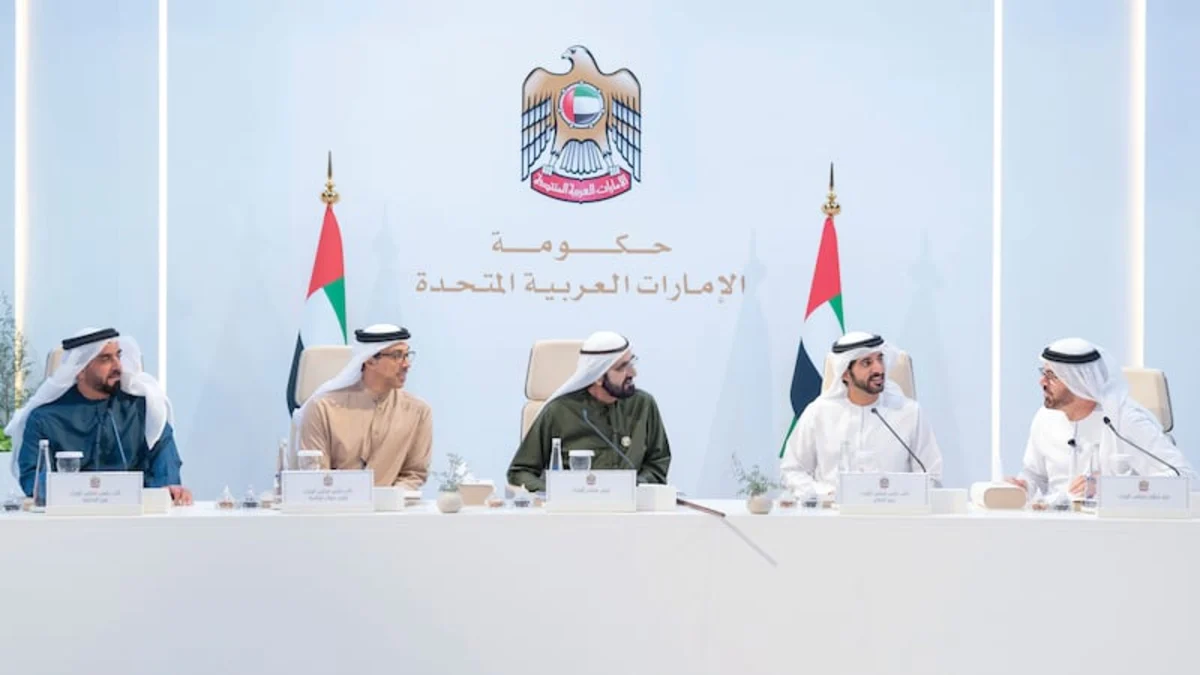
UAE Cabinet, chaired by Sheikh Mohammed bin Rashid Al Maktoum, has approved “Meera”, a unified platform intended to help people access government services through written or spoken requests. The service is due to begin a phased rollout in March 2027, as part of a wider plan to bring artificial intelligence (AI) into government operations.
Sheikh Mohammed, Vice President and Prime Minister of the UAE and Ruler of Dubai, chaired the meeting in the presence of Sheikh Mansour bin Zayed Al Nahyan, Vice President, Deputy Prime Minister and Chairman of the Presidential Court; Sheikh Hamdan bin Mohammed bin Rashid Al Maktoum, Crown Prince of Dubai, Deputy Prime Minister and Minister of Defence; Lieutenant General Sheikh Saif bin Zayed Al Nahyan, Deputy Prime Minister and Minister of Interior; and Sheikh Abdullah bin Zayed Al Nahyan, Deputy Prime Minister and Minister of Foreign Affairs.
In a post on X yesterday, Sheikh Mohammed said: “I chaired a Cabinet meeting during which we reviewed the plan to launch the personal government assistant, Meera, which will be available from next March to all customers of the UAE Government. We also directed the formation of executive teams to accelerate work on the personal assistant, and instructed all federal entities to connect their services to it according to timelines approved by the Cabinet.”
He added: “We are entering a new phase in the delivery of government services, where customers can speak to the government in their own language, obtain government services in their own words, and devote their time to their work rather than their transactions.”
Sheikh Mohammed said the Cabinet had also approved a comprehensive government strategy for agentic AI and the national technology system, FedAI. “Our goal is for the UAE Government to be the fastest, most efficient and most prepared for future technologies,” he said.
Meera to bring government services together
The Cabinet approved Meera as the UAE Government’s personal assistant and unified platform for government services. The platform is intended to strengthen the country’s use of AI to improve government operations and the customer experience.
Meera forms part of a new government operating model that aims to shift 50 per cent of UAE Government sectors, services and operations to agentic AI models within two years. The platform will allow citizens, residents, visitors and businesses to communicate with government by typing or speaking, without needing to know the name of a service or the government entity that provides it.
Users will be able to describe what they need in their own words. Meera will identify the relevant service, explain requirements and procedures, review the necessary information and coordinate with the government entities involved. Depending on the service and its availability through the platform, it will also help users complete the required steps, pay fees after obtaining users’ approval and track an application through to completion.
The platform is designed to connect related services, allowing transactions involving more than one government entity to be handled in one place. It will also support the principle of requesting information only once by using available basic government data and reducing repeated requests for information and documents. Users will be able to review their data and approve its use in line with the requirements of each service.
Services will become available gradually from March 2027, with further UAE Government services and features added regularly. The initial offering for individuals and businesses is expected to include passport and Emirates ID renewals; renewals of family members’ residency permits; birth document services; medical appointment bookings and the selection of a medical speciality and health centre; education service enquiries; access to students’ grades and exam dates; higher education programme registration; employment contract issuance and renewal; and industrial register renewals.
A national team, overseen by the National Committee for Agentic AI, will lead Meera’s development, establish governance for roles and responsibilities, set standards and controls, and monitor federal ministries and entities as they add services according to the approved work plan. The team will report progress and achievements to the Ministerial Council for AI and Development.
The Cabinet instructed all ministries and federal entities to begin developing their services for delivery through Meera and to provide the support and co-operation needed to achieve the platform’s objectives.
UAE approves agentic AI strategy and FedAI system
The Cabinet approved the UAE Government’s Agentic AI Project Strategy, which it described as the world’s first government strategy for agentic AI. Its aim is to make the UAE Government the world’s best at adopting agentic AI applications and models.
The strategy sets out a national framework to expand the use of agentic AI in government and strengthen the UAE’s global position in the field. Its three main objectives are to redefine the government operating model around agentic AI, invest in developing national talent, and establish a highly secure infrastructure for the technology.
Targets include moving 50 per cent of government operations, services and procedures to agentic AI models; training and upskilling 80,000 federal government employees; and adopting and using at least 90 per cent of agentic AI models and systems within secure government infrastructure. The strategy also aims to cut the time taken to complete government operations and develop strategies by at least 50 per cent, and improve the quality and accuracy of government outputs by 90 per cent, supporting higher customer satisfaction.
The Cabinet also approved the National Technology System for Agentic AI, known as FedAI. It will provide federal government entities with a unified technical platform to develop and operate agentic AI solutions in a secure and flexible environment, while maintaining sovereign control and supporting governance and operational efficiency.
FedAI is intended to give government entities a single route to agentic AI technologies, drawing on leading global models and platforms while reducing development and operating costs, accelerating projects and enabling the sharing of successful government solutions and practices. Its components include a secure National AI Gateway and an AI model layer that can support commercial models, sovereignly hosted open-source models and future models as they become available.
The Cabinet approved a number of national policies and initiatives to strengthen the digital infrastructure supporting AI systems and solutions. These include a National Cybersecurity Index, a National Cyber Crisis Management Framework, a National Zero Trust Security Policy and a dedicated chapter on the procurement of AI solutions in the federal government within the approved financial policies.
Investment, housing and international economic partnerships
The Cabinet reviewed progress on the National Investment Strategy 2031, which aims to strengthen the UAE’s competitiveness, reinforce its position as a leading global destination for foreign direct investment (FDI), improve the investment environment and expand international partnerships.
The UAE ranked ninth globally for FDI inflows in 2025. Annual inflows reached AED177 billion, equivalent to approximately 7.9 per cent of gross domestic product, while the total stock of FDI rose to AED1.174 trillion. Sheikh Mohammed said: “The UAE is among the world’s top ten for foreign direct investment flows, with a value of AED177 billion in 2025 and an FDI stock of AED1.174 trillion. The UAE economy continues to grow, global confidence in our country is strengthening, and our international partnerships are expanding.”
The Cabinet also reviewed the development of the UAE Atlas project and the results of the 2025 internal “Investor Voice” survey. Around nine in ten investors said they intended to invest in the UAE during the next three years. Of planned investments, 58 per cent were worth more than US$100 million, while 19 per cent exceeded US$1 billion. The results also showed an improvement in the investor journey.
A new framework for joint economic committees between the UAE and countries around the world was approved. It will bring the committees under a common umbrella and link committees established under Comprehensive Economic Partnership Agreements to them for oversight and co-ordination. A co-ordinating committee, chaired by the Ministry of Foreign Trade, will seek to unify national efforts and improve co-operation across the UAE’s economic engagement with partner countries.
The Cabinet reviewed the achievements of the Sheikh Zayed Housing Programme since its establishment in 1999. The programme has issued more than 75,000 housing support decisions worth over AED54 billion.
Working with relevant entities and national banks, the programme has developed sustainable financing policies and partnerships with the banking sector, offering solutions that take account of the needs of different groups. It has also developed connected services to make it easier for citizens to secure housing and to improve the efficiency and sustainability of housing support.
Among its initiatives is the “Senior Citizens Insurance Pool”, described as the world’s first of its kind. It enables senior citizens to obtain housing finance by covering the risks of death and total disability. The programme has also introduced the “Housing Package”, which brings housing services together in an integrated system, simplifies the process of securing a home and improves co-ordination between relevant entities.
Environment, youth and children’s culture
The Cabinet approved the UAE General Environmental Policy 2031. It aims to support a sustainable quality of life and the achievement of the Sustainable Development Goals, while providing a long-term national framework to guide public- and private-sector efforts. The policy sets national environmental commitments and objectives intended to strengthen the UAE’s regional and international leadership in environmental matters.
The Cabinet approved the third edition of the UAE State of the Environment Report 2025. The national report assesses the country’s environmental conditions, examines challenges and opportunities across environmental sectors and tracks key developments using national data, environmental surveys, federal and local reports, academic research and international partnerships.
It documents work on natural resource management, biodiversity protection, air quality, chemicals and waste management, climate change, environmental innovation and sustainable environmental governance. The Cabinet also approved the UAE’s 2025 national report on data concerning ozone-depleting substances, as part of the country’s reporting requirements under the Vienna Convention for the Protection of the Ozone Layer and the Montreal Protocol on substances that deplete it.
The National Youth Policy was approved to set guiding principles and a strategic framework for the sector. It is based on eight pillars: youth sector development; young people’s quality of life and wellbeing; future readiness and innovation; national identity and belonging; community participation; contribution to decision-making; global contribution; and sector governance.
The Cabinet also approved the National Charter for Children’s Culture in the UAE. The charter establishes a common reference for children’s cultural needs and rights, co-ordinates efforts to meet them and promotes a supportive and safe cultural environment. It recognises children as bearers of national identity and active participants in shaping the country’s cultural landscape, and sets out the shared responsibilities of relevant entities.
The charter is based on 10 rights: the right of every child to culture; to a continuing cultural journey; to develop and take pride in a cultural identity; to learn about and through the arts and culture; to a safe cultural environment; to discover, nurture and develop talents; to share cultural experiences with others; to access high-quality cultural experiences; to participate and have their voice heard; and to have their cultural rights protected.
Health, education and government standards
The Cabinet approved a decision designating the Emirates Genome Council as the authority responsible for establishing and overseeing the governance of the National Genomic Database. The decision supports implementation of Federal Decree-Law No. 49 of 2023 on the use of the human genome, which established a legal framework for regulating tests and the use of genetic and genomic data, and protecting individual rights. The database will serve as a comprehensive national reference for genetic and genomic information in the UAE.
The Cabinet also approved a federal law on fertilisers, agricultural soil improvers and pesticides. It is intended to protect human, animal and plant health and safety, as well as the environment, by regulating the registration, trade, advertising, inspection and safe use of these products.
A national framework for the classification, performance quality and oversight of higher education institutions was approved. It will establish an integrated system for assessing institutions and their branches operating in the UAE, including those in free zones. The framework will assess performance and outcomes using reliable data, identify levels of risk and direct oversight according to compliance and risk, while recognising the responsibilities of local authorities and supporting co-ordination between federal and local roles.
The Cabinet approved guidelines on gender balance in government communications. The guidance is intended to align established media concepts and practices and help build an institutional culture that considers gender balance across government communications. It sets principles and standards for messages and visual content that represent women and men in a balanced way, in line with UAE priorities and the country’s society.
Energy strategy and environmental legislation
The Cabinet reviewed implementation of the UAE Energy Strategy 2050. Installed clean-energy capacity reached 13.8 gigawatts in 2025, comprising 8.2 gigawatts of renewable energy and 5.6 gigawatts of nuclear power. Clean energy accounted for about 32 per cent of the electricity generation mix: 21.3 per cent from nuclear power and 10.5 per cent from renewables, compared with the updated national target of 35 per cent by 2031.
The UAE ranked first globally in several related international measures: ease of access to electricity in the 2026 Sustainable Development Goals Index; use of clean fuels and clean cooking technology in the Social Progress Index and the 2026 Sustainable Development Goals Index; reliability of electricity supply in the 2026 Energy Transition Index; and solar energy competitiveness in the 2025 Solar Energy Business Readiness Report.
The Cabinet also reviewed implementation of the National Hydrogen Strategy 2050 and the National Sustainable Aviation Fuel Policy. Investments earmarked for monitored projects involving hydrogen and its derivatives and sustainable aviation fuel totalled about AED41 billion. The UAE ranked first globally for competitiveness in green hydrogen production, according to the 2024 Green Hydrogen report by Alvarez & Marsal.
The Cabinet approved a biodiesel pricing mechanism in line with the National Biofuel Policy. The policy aims to regulate biofuel production and trade, increase the use of clean and renewable energy, reduce carbon emissions and support the circular economy through the recycling of used oils. It is aligned with the UAE Energy Strategy 2050 and the Net Zero by 2050 Strategy.
The Cabinet also approved the formation of a Federal Committee to Regulate the Electricity and Water Sector, chaired by the Minister of Energy and Infrastructure and including representatives of relevant federal and local entities. The committee will align national policies and strategies for electricity and water and co-ordinate electricity interconnection projects between the emirates.
A federal law on integrated environmental protection and development management was approved. It aims to protect the environment and its natural resources and services, safeguard human health and other living organisms from pollution, and ensure the sustainable development and use of natural resources while conserving biodiversity.
The law also seeks to combat environmental degradation and pollution, prevent immediate and long-term harm, raise awareness and encourage individual and collective responsibility for environmental protection, including voluntary national efforts. Its provisions cover the exploration and exploitation of natural resources, environmental and social governance, environmental security and health, greenhouse gas and pollutant emissions, and the obligations of establishments to protect the environment.
Cabinet agenda and additional decisions
The meeting agenda included approval of the Agentic AI Project Strategy; a review of the Sheikh Zayed Housing Programme’s achievements; updates to the UAE General Environmental Policy 2031 and a review of the Energy Strategy; approval of the National Youth Policy and launch of the National Charter for Children’s Culture; approval of the new framework for joint economic committees and a review of the National Investment Strategy; and the formation of the Federal Committee to Regulate the Electricity and Water Sector, chaired by the Minister of Energy and Infrastructure.
The Cabinet also approved the formation of a UAE Foreign Trade Statistics Committee, chaired by the Minister of Foreign Trade.