An Emirati venture that began with a personal investment of just AED 6,000 is bringing the practical side of satellite engineering into classrooms. SpacePoint, co-founded by Abdullah Al Salmani, has grown its cumulative investment to around AED 700,000 and delivered training programmes to more than 4,000 students, using hands-on projects to introduce young people to space technologies.
The company aims to bridge the gap between learning about space in textbooks and gaining the practical skills needed to work with advanced technologies. Its programmes give students the chance to explore satellite systems through engineering and programming activities modelled on real-world applications.
Bringing satellites into the classroom
SpacePoint was founded in 2023 after Al Salmani, drawing on his experience in the space sector and his master’s studies in space science, identified a gap between students’ theoretical education and the practical abilities needed in technology industries. The company was established to give learners direct experience with technologies used in satellite development.
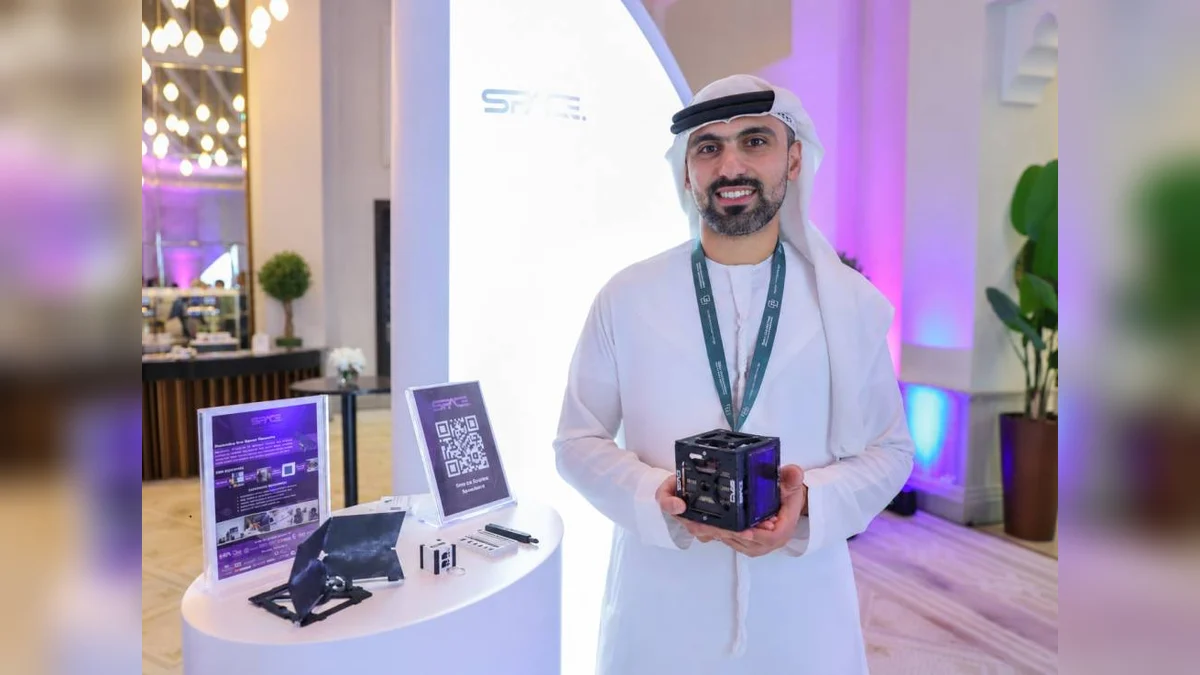
Rather than relying on conventional teaching materials alone, SpacePoint developed a complete educational package based on a miniature CubeSat measuring 10 × 10 × 10 centimetres. Students use it to explore how spacecraft systems are built and how their components work.
The activities cover electrical connections, mechanical assembly and programming. Students also take on technical challenges in teams, developing engineering skills, creativity, problem-solving and collaboration. Programmes are designed for learners aged 12 and above, from school pupils to university students and recent graduates, with content adapted to different levels of education and technical ability.
Al Salmani sees the value of these skills extending beyond the space sector. Engineering and practical experience can also be applied across advanced manufacturing, technology and other vital industries that increasingly need specialist talent.
From an initial investment to growth
Al Salmani and co-founder Abu Bakr Al Zubaidi initially invested AED 6,000 between them to develop a prototype. Investment rose to around AED 100,000 as the product was developed and the company secured its first customer. Revenue from that customer helped cover the costs of setting up the business, after which SpacePoint reinvested its profits to improve its products and expand. Its cumulative investment has since reached around AED 700,000.
Developing the product and educational package took about a year and three months. The work involved not only creating a model that replicates satellite systems, but also turning specialised engineering knowledge into accessible, practical training for students of different ages and educational backgrounds.
Al Salmani says one of the project’s main challenges was simplifying complex technical concepts without compromising their scientific basis or reducing the practical value of the training.
Connecting training with careers
Institutional partnerships have helped SpacePoint extend its reach as the business has grown. The Mohammed Bin Rashid Innovation Fund connected the company with universities and relevant organisations, opening up opportunities for collaboration and expansion. The UAE Space Agency has also supported the company through the National Space Academy and space economic zones.
SpacePoint measures its impact not only by the number of students who complete its programmes, but also by how the experience shapes their academic and professional paths. Some graduates have gone on to postgraduate study or found work in the space sector. One student, for example, received a scholarship to study at the University of California, Berkeley, in the United States.
Al Salmani says the company’s ambition goes beyond training. SpacePoint wants to build a pathway for identifying talent and supporting it after graduation, connecting learners with universities, institutions and companies that can offer employment opportunities or help them turn technical ideas into entrepreneurial ventures.
Through this approach, SpacePoint is working to strengthen an important part of the space economy: preparing people who can turn scientific knowledge into practical applications and products. Its aim is to help build a lasting base of national talent equipped to contribute to future space and technology industries.