Jumaa Al Nuaimi (Abu Dhabi)
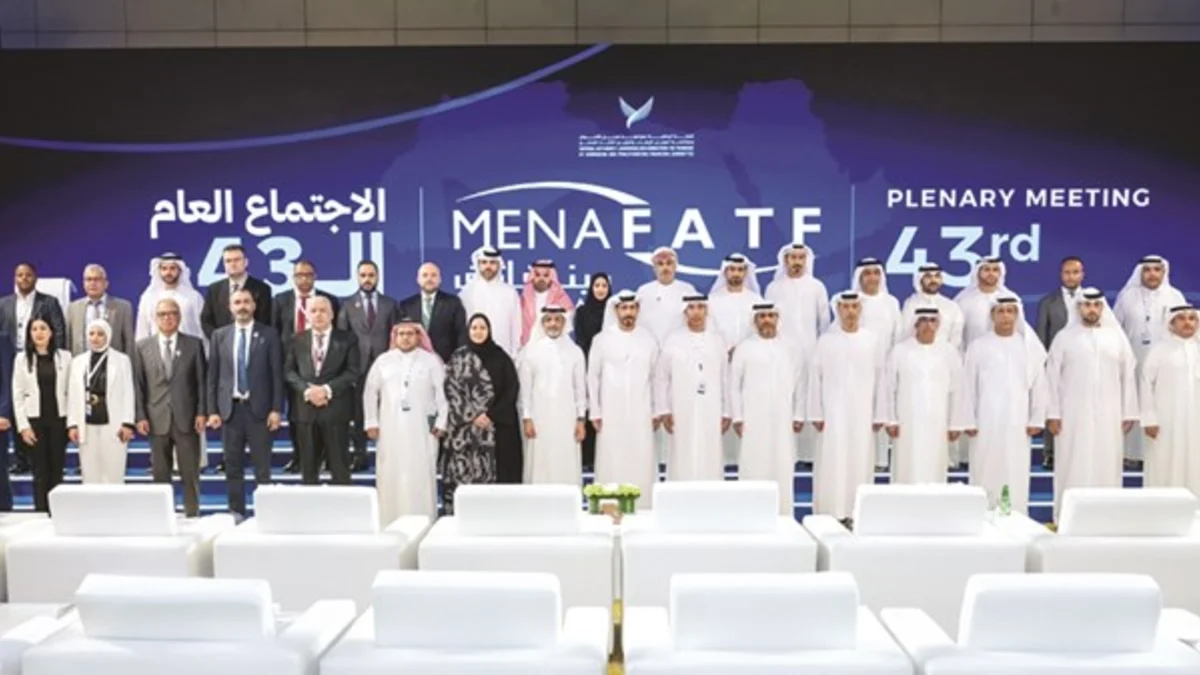
The 43rd plenary meeting of the Middle East and North Africa Financial Action Task Force (MENAFATF) opened in Abu Dhabi yesterday under the UAE’s 2026 presidency of the group. The meeting is considering ways to strengthen governance and institutional work, support member states’ readiness for mutual evaluations and deepen regional and international cooperation.
The opening was attended by Khaled Mohamed Balama, Governor of the Central Bank of the UAE and Chairman of the National Committee for Anti-Money Laundering, Combating the Financing of Terrorism and the Financing of the Proliferation of Weapons; Abdullah Sultan bin Awad Al Nuaimi, Minister of Justice; Hamed Saif Al Zaabi, President of MENAFATF; Dr Fahad bin Mohammed Al Turki, Director General and Chairman of the Board of the Arab Monetary Fund; Mai bint Mohammed Al Khalifa, Vice-President of the group; and Suleiman bin Rashid Al Jabrin, its Executive Secretary.
Priorities for the next phase
The meeting is discussing the group’s priorities for the coming period, progress in the third round of mutual evaluations and support for member states’ preparedness. Its agenda also covers technical assistance and capacity-building programmes, stronger international cooperation and partnerships with the private sector, the development of governance and institutional work, and the exchange of expertise on emerging risks. Members will also consider how to strengthen MENAFATF’s contribution to the global network for combating money laundering and terrorist financing.
A video presentation at the opening highlighted achievements during the UAE’s 2026 presidency, including initiatives undertaken with the secretariat, member states and partners. These efforts have supported preparations for mutual evaluations, advanced governance and institutional work, expanded international partnerships and strengthened capacity-building programmes.
UAE stresses integrity and international partnerships
In his opening address on behalf of the UAE, Balama thanked MENAFATF and its member states for their continued support for joint work.
He said the UAE’s approach, based on development, openness and international partnerships, reflects a firm belief that stability creates opportunities for prosperity. Protecting the integrity of the financial system, he said, is fundamental to sustaining growth, reinforcing confidence and safeguarding the gains of development. Combating money laundering, terrorist financing and the financing of proliferation is a national priority, backed by the country’s leadership. This priority represents a lasting commitment and responsibility to society, the economy and international partners.
“Given its position as a global financial and trading hub, the UAE recognises the vital role it plays in connecting markets and facilitating the movement of business and investment. The country will continue to develop its national framework and embed a culture of integrity and responsibility, ensuring this approach remains sustainable and able to keep pace with change. It will also continue its steadfast support for multilateral action and for the role of international and regional institutions in upholding international standards and building long-term partnerships based on mutual trust and shared interests,” Balama said.
He highlighted MENAFATF’s central role in strengthening regional partnerships, building confidence in financial systems and increasing the region’s contribution to international efforts. The UAE, he said, was committed to supporting the group’s work during its 2026 presidency in the interests of member states and the stability and prosperity of the region.
Regional cooperation against financial crime
Al Zaabi said the regional effort to combat financial crime grows stronger as each member state makes progress. Every success by a member state, he said, helps the region protect its financial systems. The meeting comes at a time when greater preparedness and coordinated efforts are needed, and national progress must be matched by effective, sustained regional cooperation against cross-border risks.
He said high-level institutional commitment is essential to successful national efforts. It must be translated into clear priorities, effective institutional coordination and cooperation between relevant authorities and the private sector, as well as tangible results in detecting crime, tracing and confiscating its proceeds, and strengthening international cooperation.
Al Zaabi described the third round of mutual evaluations as an opportunity to improve the effectiveness of national systems, consolidate reforms and direct efforts in line with risks. MENAFATF will continue to support member states through preparation, evaluation and follow-up, while ensuring assessments remain objective, high-quality and consistent.
He also stressed the importance of supporting countries facing exceptional circumstances and challenges, maintaining safe and formal financial channels, and investing in human expertise and specialist knowledge. Academic institutions, research centres and training bodies, he said, can also contribute to developing capabilities and understanding emerging risks.
Economic impact and financial channels
Dr Al Turki emphasised MENAFATF’s economic impact and the importance of confidence in institutions’ ability to understand and manage risks to the region’s economic interests. Arab countries had made progress in developing their legislation, he said, and the Arab Monetary Fund was keen to continue its cooperation with the group.
He outlined three priorities: directing supervisory decisions and allocating resources according to risk-assessment findings; improving institutions’ ability to trace and recover criminal proceeds; and keeping legitimate financing channels open. He also highlighted the need to enable financial intelligence units to use information promptly, strengthen regional cooperation and speed up responses by counterpart authorities. Preserving legitimate financing channels, he added, was a particular concern for the fund, and a risk-based approach was important to achieving this.
First mutual evaluation report under the third round
Al Jabrin thanked the UAE for hosting MENAFATF’s 43rd plenary meeting and for its support during the country’s 2026 presidency of the group.
He said the meeting came at an important stage, with members discussing the group’s first mutual evaluation report under the third round. The report will help assess the effectiveness of anti-money laundering and counter-terrorist financing systems in the region, their ability to adapt to emerging threats and risks, and their efforts to protect financial integrity and international reputation.
The secretariat has organised sessions and events to help member states develop their systems. These include a session examining the mutual evaluation experiences of countries outside the region and the lessons learned from those experiences to support members’ preparations for their own evaluations.
Al Jabrin also highlighted the group’s interest in strengthening cooperation with scientific research centres and their role in studying money laundering, terrorist financing and the financing of proliferation.
Proposed regional initiative on fraud
A proposal for a regional initiative to study patterns of fraud and related money-laundering activity is due to be presented at the meeting. It aims to help develop a more proactive and effective regional response, drawing on national experience and international expertise.
The proposal focuses on prevention and early warning, information-sharing between competent authorities, financial institutions and digital platforms, and speeding up the tracing of criminal proceeds, including virtual assets. It also aims to support the recovery and return of funds.
The video presentation on the UAE’s presidency also highlighted direct engagement with Syria, Jordan and Palestine to support national efforts and strengthen preparedness and institutional coordination. Meetings with Djibouti and Somalia focused on technical assistance and training needs, reflecting the group’s approach of responding to the priorities and circumstances of its members.