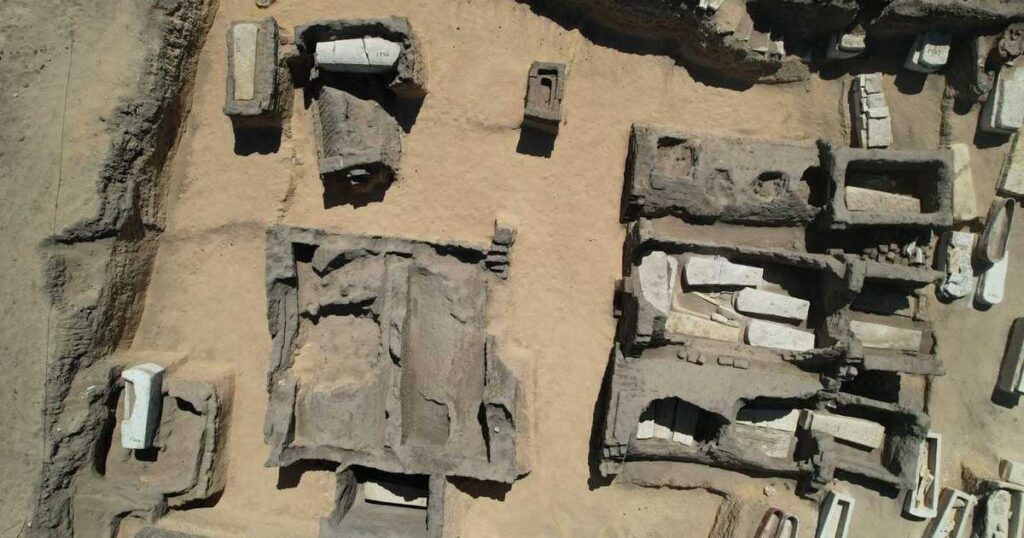
In an extraordinary archaeological discovery, a team from Egypt’s Supreme Council of Antiquities has unveiled a burial site dating back over 2,200 years, revealing significant insights into the late Pharaonic, Ptolemaic, and early Roman periods. Preliminary studies suggest that the majority of the burials originate from the 3rd and 2nd centuries BCE.
An Abundant Archaeological Site
The burial site comprises stone and pottery coffins, as well as remnants of wooden sarcophagi. Notable structural features include domed tombs built from mudbrick and others constructed from limestone. Egyptian Minister of Tourism and Antiquities, Sherif Fathy, remarked that this discovery shines a light on new aspects of ancient Egyptian civilization and highlights the evolution of funerary practices across the ages.
Unique Findings and Architectural Features
Secretary-General of the Supreme Council of Antiquities, Hisham Al-Lithy, expressed that this find is unprecedented in the region concerning the number of burials and coffins discovered within an open burial courtyard. Additionally, there are other architectural elements still buried beneath the sands.
Initial analyses suggest that the necropolis was designated for the interments of middle-class individuals, based on the nature of the archaeological finds and the funerary objects accompanying the burials.
Golden Artefacts and Rare Amulets
The excavation has uncovered a remarkable array of artefacts, including gold tongues, strips, a gold ring, and a pendant, alongside scarabs, amulets, and a large number of faience “ushabti” figurines, some of which bear hieroglyphic inscriptions. Additionally, remains of pottery coffins featuring human-like shapes were discovered, along with burial deposits containing traces of embalming materials and resins, as well as remnants of colourful plaster and cartonnage used in mummification.
The discoveries also included statues of the goddesses Isis and Aphrodite, alongside representations of the Sphinx and the falcon-headed deity Horus, as well as two buried falcons found among the coffins.
Mohamed Abdel Badie, head of the Egyptian antiquities sector at the Supreme Council of Antiquities, noted that these findings reflect the continuity of beliefs and funerary practices associated with ancient Egyptian religion, particularly the worship of Osiris, Isis, and Hathor.
A Historical Context
Located within the archaeological zone of the ancient city of Trana, the burial site is situated at the eastern entrance of Wadi Natrun, historically renowned for the extraction of natron salt used in mummification processes. The excavation team is set to continue their work, focusing on further excavations, documentation, and scientific studies aimed at unearthing more secrets of the necropolis and understanding the lifestyle and religious beliefs of its inhabitants during that historical era.