
Sharjah 24
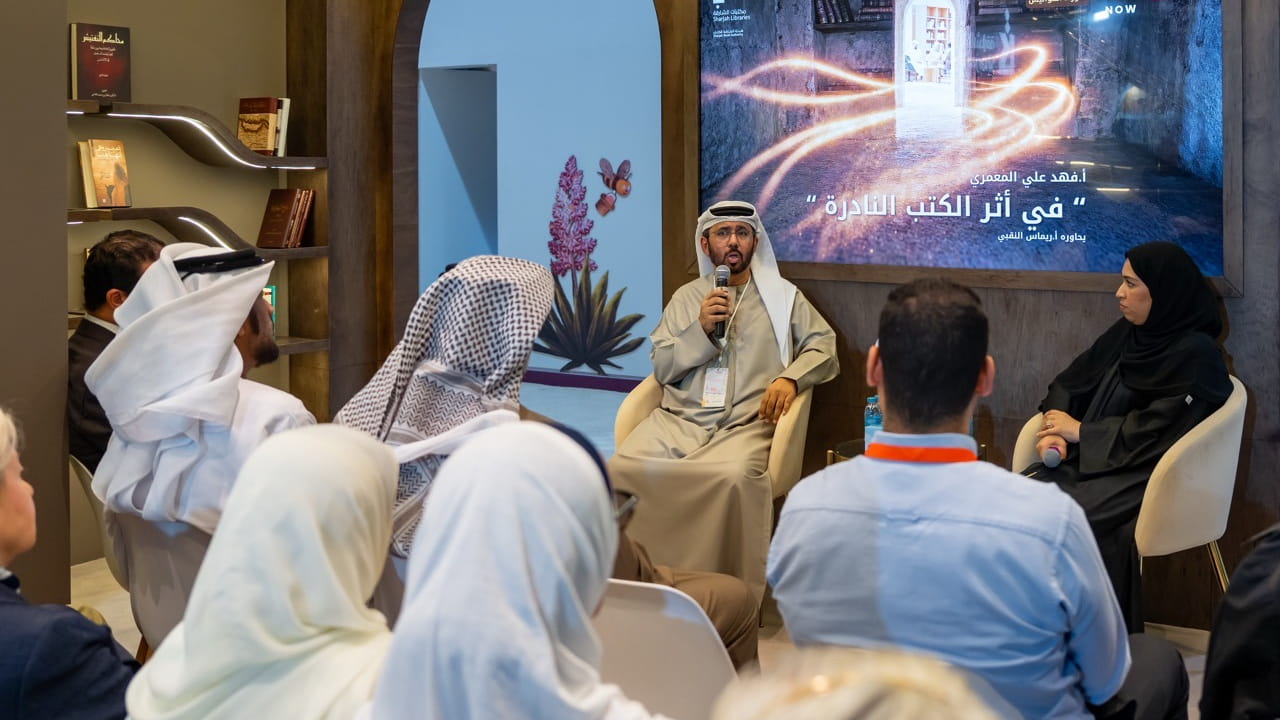
In a recent session titled “In Pursuit of Rare Books,” held by Sharjah Public Libraries as part of the 45th Sharjah International Book Fair cultural programme, Fahad Ali Al-Muammari, the Chairman of the Emirates Association for Libraries and Information, emphasised the significance of tracing the history of first editions of Arabic books. During the dialogue, facilitated by Rimas Al-Naqbi, Al-Muammari shared his personal journey of over 35 years in collecting books, which has led him to establish a home library containing nearly 12,000 titles, including original and rare editions from the 19th century.
Understanding the Rarity of Books
Al-Muammari highlighted that time is a fundamental criterion for determining a book’s rarity. Books that are over a century old inherently carry historical importance, yet their rarity can vary significantly based on the title and the number of surviving copies. For instance, a book aged 120 years may still have over a hundred copies scattered across libraries worldwide, while a modern release can be classified as highly rare if it was published in a limited commemorative or annual edition or by a governmental body, including royal diwan publications.
Key References on Early Editions
During the session, Al-Muammari pointed out essential resources for those interested in the history of rare books. Among these, he recommended “Dictionary of Arabic and Arabised Publications” by Youssef Serkis, which documents publications up until 1927 and serves as a crucial reference for researchers in the field of Arabic publishing history. He also mentioned Edward Van Dyck’s 1896 work, “Satisfaction of Content with What Is Printed.”
The Impact of European Printing History
Al-Muammari stressed the importance of studying the history of European printing, referencing Johannes Gutenberg’s editions and the Italian prints, particularly those from the Medicis that facilitated the publication of numerous Arabic books during the 16th century. He asserted that these sources are vital for identifying locations of rare books and tracing their printing history.
Spotlight on Notable Collectibles
Al-Muammari showcased some highlights from his private library, particularly focusing on the book “The Long-Lived Among the Arabs and Their News and Poems” by Abu Hatim Al-Sijistani. This title was first printed in Leiden in 1899, marking a transition from manuscript to printed book. Al-Muammari proudly possesses an original copy of the Egyptian edition released in 1905, just six years after the initial publication. He noted that the book was republished in 1960 under the name “The Long-Lived and the Testaments,” combining it with another work which contributed to the increased rarity of the original first edition.
He also revealed his pride in owning a first edition of “The Number of the States in Historical Context” by Lisan Al-Din Al-Khateeb, published in Tunisia in 1896 using lithographic printing methods—another treasure that retains its historical significance due to its association with early printing techniques.