
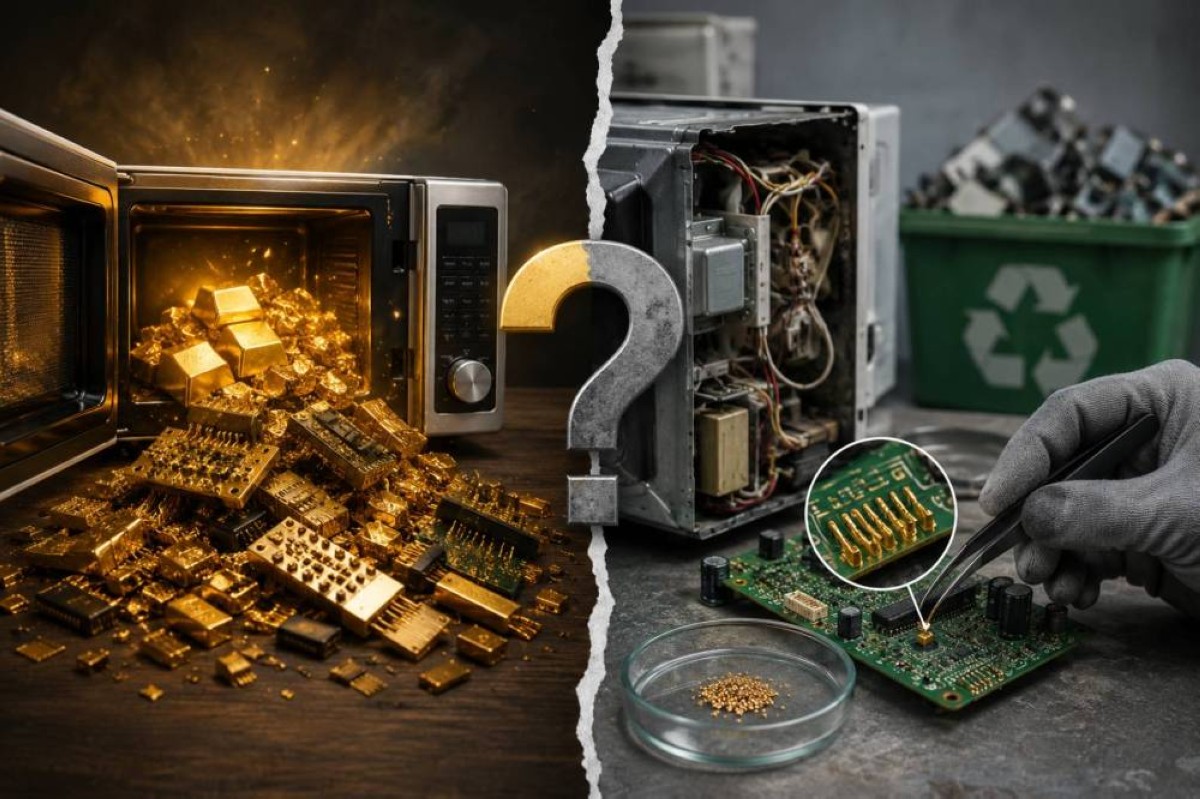
In a world where interest in recycling electronic waste is growing, numerous questions arise about the amount of gold contained in household devices. Scientific research leads to astonishing discoveries, yet the reality may be more complex than we think. What precious metals do microwaves, mobile phones, and old computers contain? Can their quantities be considered hidden treasures, or are they merely crumbs in the broader context of industrial efforts? The amount of gold found in household devices is a fascinating topic worth exploring.
Discovering Gold in Household Devices
Recent studies in the field of electronic waste recycling indicate that some unused household devices, such as microwaves, contain small amounts of gold within their internal components. Gold is used in certain circuit boards and electrical connectors due to its unique properties, such as high electrical conductivity and resistance to corrosion. These properties ensure the stability of connections within devices over the long term, particularly at contact points and sensitive circuits. However, the amount of gold present in each device remains extremely limited, making it difficult to consider it a profitable source by dismantling just one device.
Economic Challenges of Gold Extraction
Experts in recycling assert that the economic feasibility of extracting gold only becomes apparent when processing vast quantities of electronic waste in advanced industrial operations. According to scientific reports, the true value of gold within devices is found in the industrial framework, where quantities are larger and processes are more efficient. Many researchers have confirmed that attempting to extract gold from a single device using home methods will not yield an economic return. Moreover, experts warn about the potential health risks associated with handling internal components, which may contain harmful substances requiring specialized processing.
New Methods for Gold Extraction
A recent study conducted at the Swiss Federal Institute of Technology in Zurich explored innovative methods for extracting gold from electronic waste. The study utilized a sponge made from protein fibers extracted from food industry waste. Researchers managed to extract a small mass of 22-carat gold weighing 450 milligrams from 20 old computer circuit boards. While rumors circulated about extracting gold from microwaves, actual results indicate that this can be achieved more efficiently by processing large piles of electronic waste.
The Sustainable Future of Recycling
The issue of “urban mining” is one of the modern solutions for dealing with electronic waste, wherein old devices are collected and subjected to sorting and processing to recover precious metals such as gold, silver, and copper. Estimates suggest that many electronic devices contain small quantities of these metals, highlighting the importance of organized recycling as a significant economic and environmental option. Furthermore, it is advisable to deliver unused devices to certified collection points or licensed recycling companies instead of disposing of them in household waste.
While the presence of gold in household devices captures attention, experts agree that the reality is that this metal does not constitute a “hidden treasure” in every home. Rather, it is a low-value industrial resource whose impact is seen in a broader context that relies on advanced technologies and specialized recycling infrastructure. Therefore, investing in knowledge and modern technologies remains key to better understanding the value of gold within household devices.